
Desert landscapes that will leave you speechless
Index
Desert landscapes that will leave you speechless
Desert landscapes are some of the most surprising and enigmatic settings on the planet. Although many people tend to associate them with an empty, inhospitable or lifeless environment, the truth is that they hide a natural, cultural and spiritual wealth that leaves a mark on those who visit them. Its immensity, clear skies, and changing colors make every view an unforgettable spectacle.
These arid territories represent almost a third of the earth’s surface and are spread over all continents. Each of them is different: some stand out for their golden dunes that look like endless waves of sand, others for their rock formations shaped by wind and time, and some even for the unique contrasts they offer with nearby seas or mountains.
Traveling to a desert is not only a tourist experience, but also a way to connect with yourself. The solitude and calm that these places transmit generate a sense of introspection that is difficult to match in other landscapes. At the same time, they are also surprising for the biodiversity they have been able to develop: species of animals and plants that have learned to survive in extreme conditions, demonstrating the strength and adaptability of nature.
Throughout this tour we will explore some of the most fascinating desert landscapes in the world, from the vastness of the Sahara to the mystery of Wadi Rum. Get ready to discover places that seem to be from another planet, but are much closer than you imagine.


The Sahara Desert: Golden Immensity
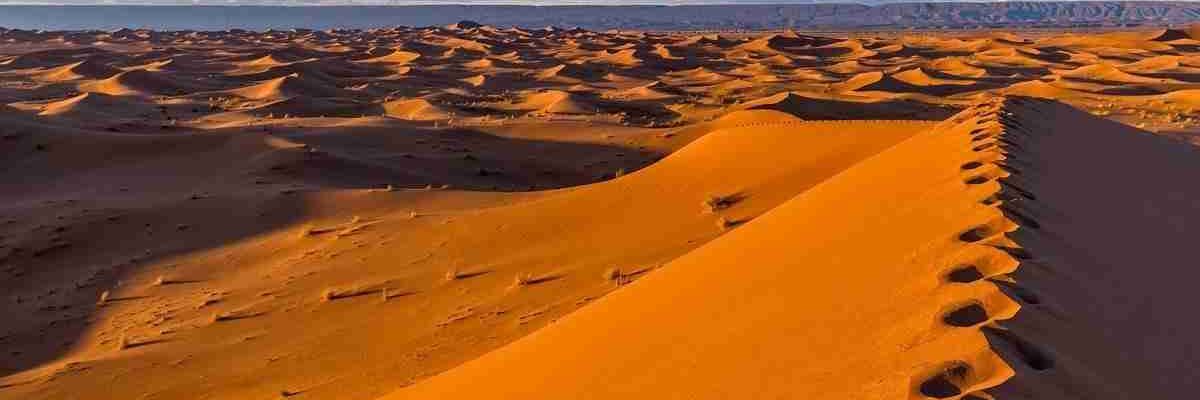
To talk about desert landscapes is to talk about the Sahara, the largest and most famous desert on the planet. With more than 9 million square kilometers, this sea of sand extends through 11 African countries, offering a diversity of scenarios that go beyond the classic golden dunes that have made it world famous.
The Sahara surprises with its changing landscapes: from vast stony plains to dunes that reach more than 180 meters in height, passing through green oases that appear like mirages in the middle of nowhere. In addition, the history and culture of the nomadic peoples who inhabit these lands enrich the experience, allowing the traveler to learn about ancestral traditions linked to the desert.
One of the great attractions for tourists is the possibility of touring it by camel or off-road vehicles, camping under a starry sky impossible to see in modern cities. The lack of light pollution turns the Saharan nights into a real natural planetarium, where the Milky Way is shown in all its splendor.
The Sahara is not only nature; it is also living history. It was the scene of ancient trade routes, where caravans transported gold, salt and spices, connecting cultures across the desert. Today, traveling through it means immersing yourself in an adventure that combines mystery, beauty and a sense of smallness in front of the immensity of the earth.
To explore the Sahara is to contemplate one of the most impressive desert landscapes on the planet, a place that seems eternal and continues to captivate those who visit it.
Atacama in Chile: the driest desert in the world
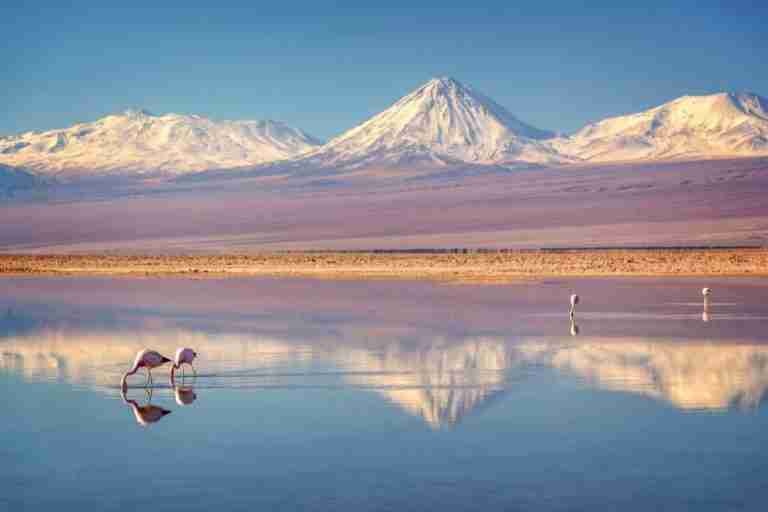
South America is home to one of the most impressive desert landscapes in the world: the Atacama Desert. Located in the north of Chile, it is considered the driest place on the planet, with areas where it has not rained in hundreds of years. However, far from being an empty lot, Atacama is a mosaic of colors, shapes and experiences that make it an essential tourist destination.
Among its main attractions are the salt flats, extensive white plains covered with salt that reflect sunlight like natural mirrors. Also striking are the Tatio geysers, where columns of steam emerge from the ground in a spectacle that seems to be taken from another world. Added to this are altiplanic lagoons with crystal clear waters, surrounded by volcanoes and coloured mountains, which contrast with the aridity of the environment.
But if there is one thing that makes the Atacama unique, it is its skies. The combination of altitude, dryness, and absence of light pollution makes this desert one of the best places on the planet for stargazing. It is no coincidence that some of the most important astronomical observatories in the world are located there.
The Atacama Desert is also home to communities that have been able to adapt to its extreme conditions, keeping alive their customs and their spiritual relationship with the land. To visit it is to discover that, even in the most hostile environments, life makes its way and gives unforgettable postcards.
Without a doubt, the Atacama is one of the most amazing and beautiful desert landscapes on Earth.
Monument Valley in the United States: the desert of cinema
On the border between Utah and Arizona stands Monument Valley, one of the most recognizable desert landscapes thanks to cinema. Its towering rock formations, known as “mesas” and “buttes,” have been the setting for countless western movies, becoming a symbol of the collective imagination about the deserts of North America.
Beyond its cinematic fame, Monument Valley is a place steeped in spirituality. This territory belongs to the Navajo Nation, and for its inhabitants it has a deep cultural and sacred value. Walking its trails with local guides allows you not only to admire its breathtaking views, but also to learn about the stories, legends and traditions that are part of its identity.
The sunsets in Monument Valley are one of its biggest draws. The sun dyes the rock formations in reddish and golden tones, generating a spectacular contrast with the open sky. Each change of light transforms the landscape, offering the visitor a visual experience that is never repeated in the same way.
Another unmissable experience is to tour the valley by vehicle or on horseback, as the Native Americans and, later, the settlers did. This experience transports the traveler to another era, when nature dictated the rhythm of life.
Monument Valley is much more than a movie set. It is one of the most emblematic desert landscapes on the planet, a place where nature, culture and history are intertwined in a visual and emotional spectacle.
The Namibian Desert: Dunes That Meet the Sea
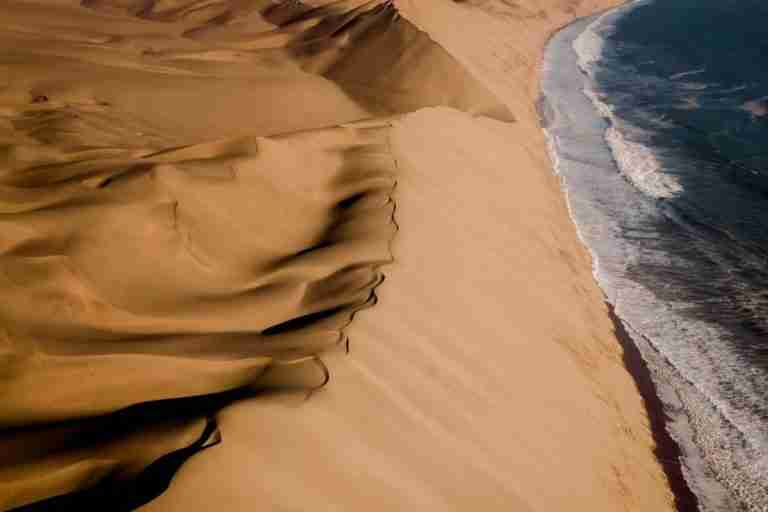
In southwest Africa lies one of the most fascinating desert landscapes : the Namibian desert. This place is known for its reddish dunes, considered the highest in the world, some of them reaching up to 300 meters in height. The intensity of its colors at sunrise and sunset turns every moment into a natural work of art.
What makes the Namibian desert unique is its direct contact with the Atlantic Ocean. On the so-called Skeleton Coast, the dunes plunge until they meet the sea, creating an overwhelming contrast between the red of the sand and the blue of the water. This phenomenon is not repeated in any other desert on the planet, which increases its tourist attraction.
Wildlife also surprises in this extreme environment. Desert-adapted elephants, oryx, and jackals coexist in an ecosystem that seems impossible. Safaris in Namibia allow you to observe these animals in the wild, while the visitor marvels at nature’s ability to adapt to adverse conditions.
Among the most emblematic places is Sossusvlei, a valley surrounded by giant dunes where dry trees contrast with reddish sand. This image is one of the most photographed icons in the country.
The Namibian desert is undoubtedly one of the most beautiful desert landscapes in the world. A unique combination of colors, wildlife, and the indomitable force of nature.
Wadi Rum in Jordan: A Landscape From Another Planet
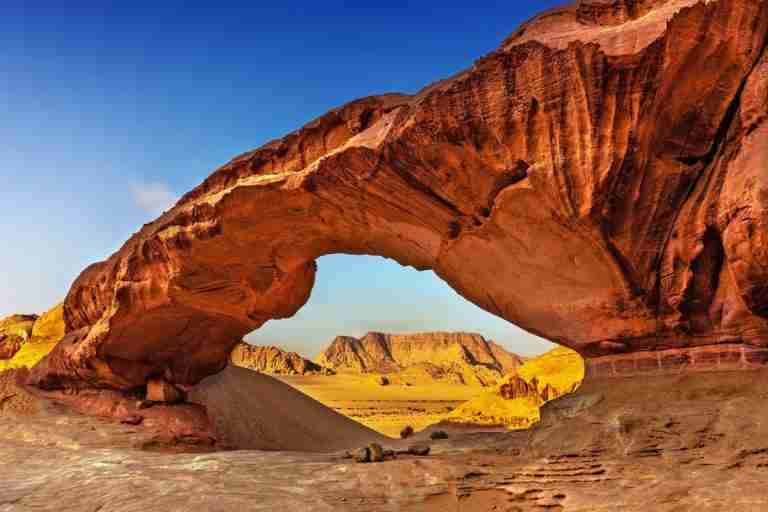
Known as the Valley of the Moon, Wadi Rum is one of the most striking and unique desert landscapes . Located in Jordan, this desert of sandstone and granite looks like something out of another planet, which is why it has been the setting for numerous science fiction films, including recreations of Mars.
What sets Wadi Rum apart is its sandstone mountains, which rise imposingly amidst vast reddish plains. The rock formations, sculpted by the wind over millions of years, create natural arches, canyons, and labyrinths that invite exploration.
This desert is closely linked to the history of Lawrence of Arabia, who walked through it and described it as a “vast, resonant and divine” place. Today, travelers can follow in their footsteps on jeep, camel or even hot air balloon tours, enjoying panoramic views that seem unreal.
In addition, Wadi Rum is home to Bedouin communities that maintain their ancestral traditions. Staying in their camps is a unique opportunity to experience Arab hospitality, enjoy the local cuisine and sleep under one of the most starry skies on the planet.
The experience of touring Wadi Rum transcends tourism. It is to enter an environment where nature shows its greatness and where the human being feels tiny. Without a doubt, it is one of the most unforgettable desert landscapes in the world, capable of transporting you to another dimension.
Tips for enjoying desert landscapes
Visiting desert landscapes can be a magical experience, but it also requires preparation and precautions. These environments, although fascinating, present extreme conditions that are important to take into account to enjoy the trip safely.
First of all, hydration is essential. Temperatures are usually very high during the day and dry air causes rapid dehydration. It is recommended to always carry enough water and avoid prolonged exposure to the sun in the middle of the day.
The right clothing also makes a difference. It is advisable to wear light, breathable and light-colored clothing, as well as a hat or scarf that protects the head. At night, temperatures can drop sharply, so it is also advisable to wear warm clothes.
The use of sunscreen and sunglasses is essential, as solar radiation in deserts is very intense. It is also useful to wear comfortable and sturdy shoes, especially if you plan to walk on dunes or rocky terrain.
Another important aspect is to respect the environment. Desert landscapes are fragile and unique, so it is advisable to avoid leaving garbage, damaging the flora or disturbing the local fauna. Hiring local guides not only ensures safety, but also enriches the experience with cultural and natural knowledge.
Finally, it is recommended to plan your visit well, know the best time of year for each desert and, above all, open yourself to the experience. Traveling to the desert is not just tourism: it is a deep connection with nature and with oneself.
Conclusion: The Timeless Magic of Desert Landscapes
Desert landscapes are much more than expanses of sand under a scorching sun. Each of them contains stories, cultures and natural beauties that surprise those who enter its immensity. From the Sahara, with its infinite grandeur, to Wadi Rum, which seems to be taken from Mars, the deserts of the world teach us the diversity of forms that nature adopts in the most extreme environments.
Visiting a desert is a transformative experience. Not only because it offers unparalleled views, but also because it invites reflection and inner connection. The silence, the solitude and the magnitude of these places generate a sensation that is difficult to describe, but impossible to forget.
Each of the destinations mentioned—Atacama, Monument Valley, Namibia, Wadi Rum, and the Sahara—shows us that deserts, far from being dead lands, are full of life, color, and meaning. They are home to ancient traditions, unique geological phenomena and surprising biodiversity.
Deserts remind us that beauty is not always found in the obvious, but also in austerity, endurance and the ability to adapt.
Those who dare to discover desert landscapes also discover a part of themselves. And it is that in those infinite horizons, time seems to stand still and nature reveals its purest and most majestic side.