
Traveling through the Empires of the Past
Index
Travel through time and empires of the past
Traveling does not always mean moving towards new horizons; sometimes, it involves looking back at the roots that shaped the world. There is something profoundly transformative about walking the same paths that emperors, philosophers, and warriors trod. Every stone, every ruin, every temple whispers stories of glory, power, and humanity. Traveling through the empires of the past is much more than a tourist experience: it is an intimate encounter with the soul of civilizations that still live in art, architecture, and collective memory.
When we explore the remains of these ancient kingdoms, we understand that time does not erase, it only transforms. From the sands of the Egyptian desert to the mountains of Peru, the empires of the past continue to await the traveler who seeks to understand the origin of beauty, wisdom and power. Each destination invites us to relive a different era, to contemplate what we were and what we continue to be. This journey not only crosses continents, but also the history of humanity.


The Legacy of the Roman Empire: Paths That Still Guide the Modern Traveler
Few civilizations left such a deep mark as the Romans. His empire, vast and ambitious, extended its influence from the British Isles to the Sahara desert, and from the Iberian Peninsula to the sands of Mesopotamia. To travel through the empires of the past is, in large part, to follow in the footsteps of the Roman Empire, whose paths and monuments still mark the pulse of Europe.
In Italy, Rome stands as a living museum: the Colosseum, eternal symbol of power and engineering; the Roman Forum, where the threads of politics and destiny were woven; and the hot springs, places of meeting and rest. Beyond Rome, cities such as Pompeii and Herculaneum show us an instant frozen in time, preserved by the tragedy of Vesuvius.
But the Roman legacy does not end in Italy. The aqueducts of Segovia in Spain, the amphitheatres of Nîmes and Arles in France, or the remains of walls and towns in England, are silent witnesses of an empire that knew no borders. To travel among these ruins is to follow the paths that still lead Europe today, remembering that the empires of the past continue to build the present.
Egypt: the eternal cradle of the pharaohs and their mysteries
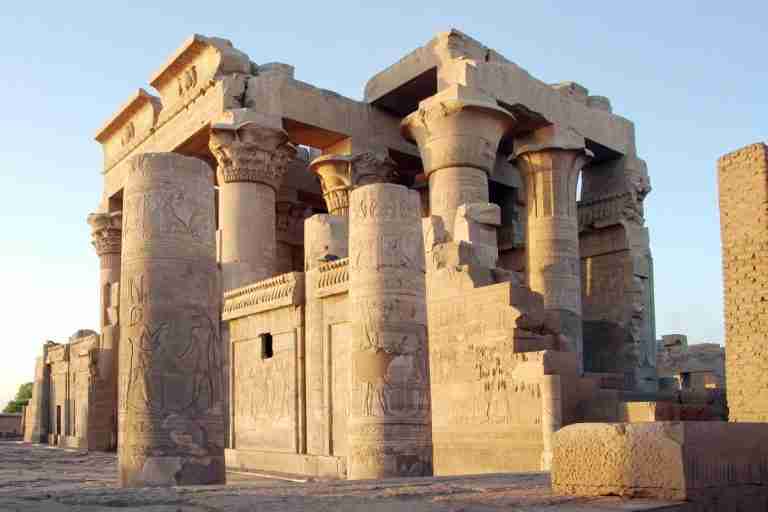
If there is a place that embodies the mystery and grandeur of the empires of the past, it is Egypt. On the banks of the Nile, under the desert sun, stand the pyramids of Giza, millenary guardians of a legacy that defies time. To contemplate the Sphinx at dawn or to walk through the Valley of the Kings is to immerse yourself in a world where the gods walked among men.
Egypt invites the traveler to look beyond history and enter the spiritual. The temples of Luxor and Karnak speak of a deep faith, where every column and hieroglyph is a hymn to the cosmic order. To sail on the Nile, as the ancient pharaohs did, is to feel eternity flowing under the skin. Abu Simbel, with its colossi looking at the horizon, recalls the greatness of Ramses II and the human obsession with transcending.
But beyond the stones and monuments, Egypt vibrates in the daily lives of its people, in the markets of Cairo, in the incense and the song of the muezzin. To travel through Egypt is to walk among shadows and lights, between the earthly and the divine, in a country where the past never dies, it only becomes myth.
Classical Greece: The Origin of Thought and Beauty
Between mountains bathed by the Aegean Sea, Greece holds the echoes of a civilization that invented Western philosophy, democracy and art. Traveling through the empires of the past inevitably takes us to this corner of the world where the human reached its maximum expression. Athens, with its Acropolis lit up at sunset, seems suspended between heaven and earth, recalling the gods who once inhabited its hills.
Delphi, considered the navel of the ancient world, invites the traveler to listen to the voices of the oracle and to reflect on their own destiny. In Olympia, where the games that still unite humanity today were born, the spirit of competition and harmony is still felt among the ruins. The Greek islands, such as Santorini or Crete, preserve the essence of myth and the serenity of the sea that inspired poets and heroes.
In Greece, every stone speaks of the human desire to understand the universe. Here the concepts of beauty and proportion were born, the ideas that continue to guide modern art. To travel through this country is to travel through the mind and heart of the empires of the past, where reason and passion merged into a single culture.
Empires of the East: China, Japan and the Echoes of Silk
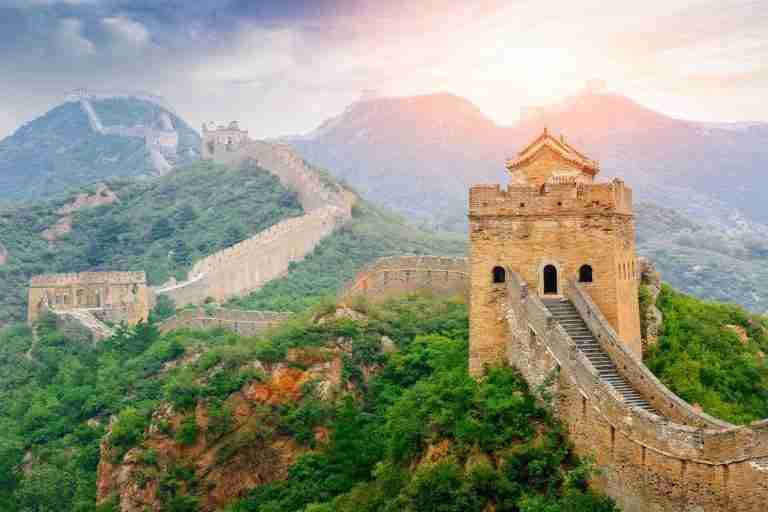
In the far east of the world, empires flourished that rose with the patience of time and the wisdom of tradition. China, with its Great Wall winding through mountains, shows the power and perseverance of a nation built on millennia. In Beijing, the Forbidden City reveals the splendor and mystery of the dynasties that ruled with balance and ritual. To travel through these empires of the past is to immerse yourself in a world where art and discipline merge in harmony.
Beyond that, Japan offers another kind of greatness, subtle and silent. Kyoto, with its golden temples and Zen gardens, is a haven of the spirit. In Nara, deer coexist with deities, reminding us that nature was always a sacred part of the Japanese soul. Ancient samurai routes and feudalist castles evoke a time when honor was more valuable than life itself.
Both empires, although different, share the same invisible thread: respect for memory, art and harmony. To explore its palaces, pagodas and landscapes is to discover that the empires of the past still beat with the same serenity with which they were conceived.
The Splendor of the Pre-Columbian Empires in America
Long before the arrival of Europeans, America was the scene of extraordinary civilizations. The empires of this continent’s past left behind monuments that defy imagination and science. Machu Picchu, suspended between mountains and clouds, holds the secrets of the Inca Empire and its architectural wisdom. Each stone fits together with mystical precision, as if the earth itself had participated in its construction.
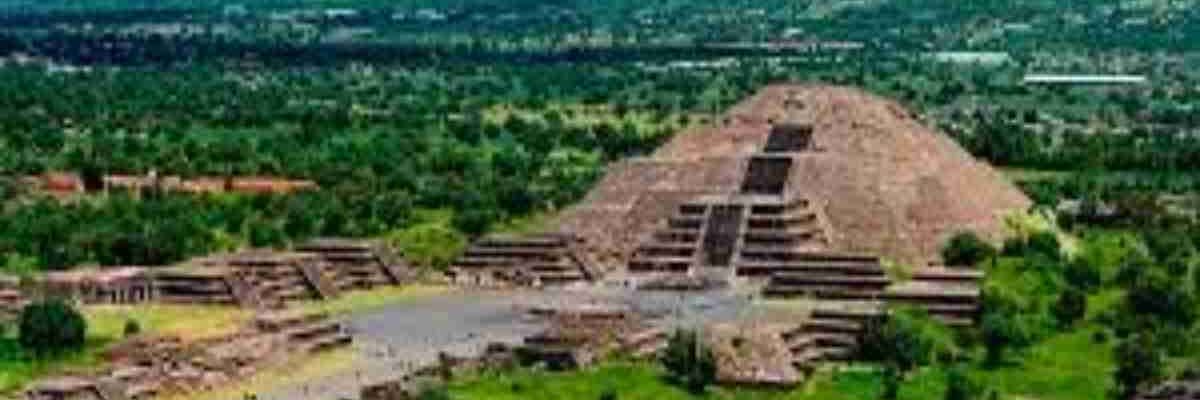
In Mexico, the pyramids of Teotihuacan and the ruins of Chichen Itza speak to the power and knowledge of the Mayans and Aztecs. Astronomy, mathematics, and spirituality were intertwined in stargazing temples that celebrated the eternal cycle of life. In Central America and the Andes, the remains of these cultures invite the traveler to imagine a humanity deeply connected to nature and the gods.
To explore these empires is not only to admire their greatness, but to understand their vision of the world: one where man was part of the cosmos, not its owner. With each step through these sacred lands, the empires of the past whisper to us that there is still much to learn from those who lived before us.
The Power and Greatness of the Ottoman Empire
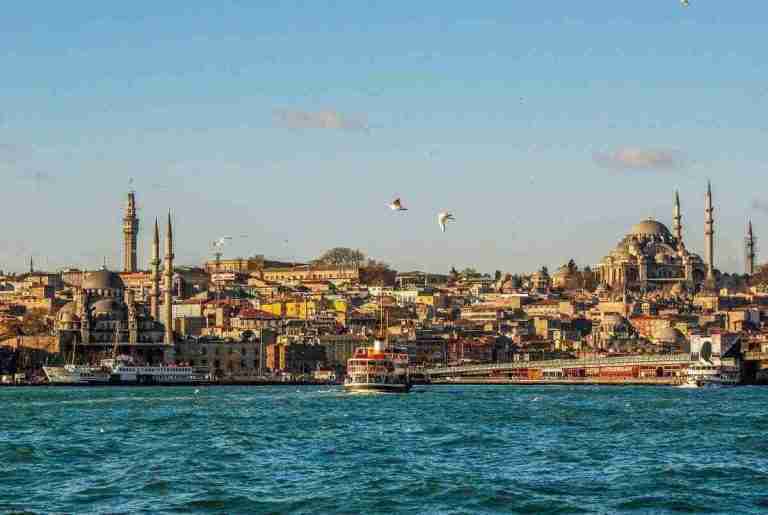
Between Europe and Asia, where the winds of two worlds cross, the Ottoman Empire was built. Its heartland, Istanbul, remains a stage where East and West meet in an eternal dance. The city’s skyline, crowned by minarets and domes, tells stories of sultans, merchants, and dreamers who forged an empire of splendor.
The Blue Mosque, Topkapi Palace, and Hagia Sophia are architectural gems that speak of a refined, powerful, and deeply spiritual civilization. The bazaars, with their scents of spices and silks, preserve the essence of the trade that united continents. To travel through the empires of the Ottoman past is to travel routes where cultures, languages and religions converged, creating an incomparable human mosaic.
Beyond Istanbul, cities such as Bursa, Edirne or Damascus reflect the lasting influence of Ottoman power. Each dome, each mosaic, each fountain, holds a fragment of universal history. In this empire, art was not only beauty, but also devotion and power. Today, the echoes of that time continue to resonate in the songs of mosques at sunset.
Conclusion: rediscovering the world through the empires of the past
Traveling through the empires of the past is much more than visiting ruins or contemplating monuments: it is an inner search. In every civilization we find a part of ourselves, a teaching about time, faith, and human creativity. The remains of the Roman Empire tell us about ambition and structure; Egypt, of eternity and mysticism; Greece, of reason and beauty; East, of balance and harmony; Pre-Columbian America, of connection with the land; and the Ottoman world, of diversity and splendour.
As we walk through these places, we understand that the past is not a static memory, but a living presence that inspires us to be better travelers and better human beings. The empires of the past not only built cities, but also dreams, and by exploring them, we rediscover the essence of our own civilization.